The Craft of Silk Twill
Four disciplines define a scarf worthy of a maison — the weave, the print, the edge and the silk itself. Below is how each one is practised, what happens between your artwork and a packed order, and what every specification choice actually changes.
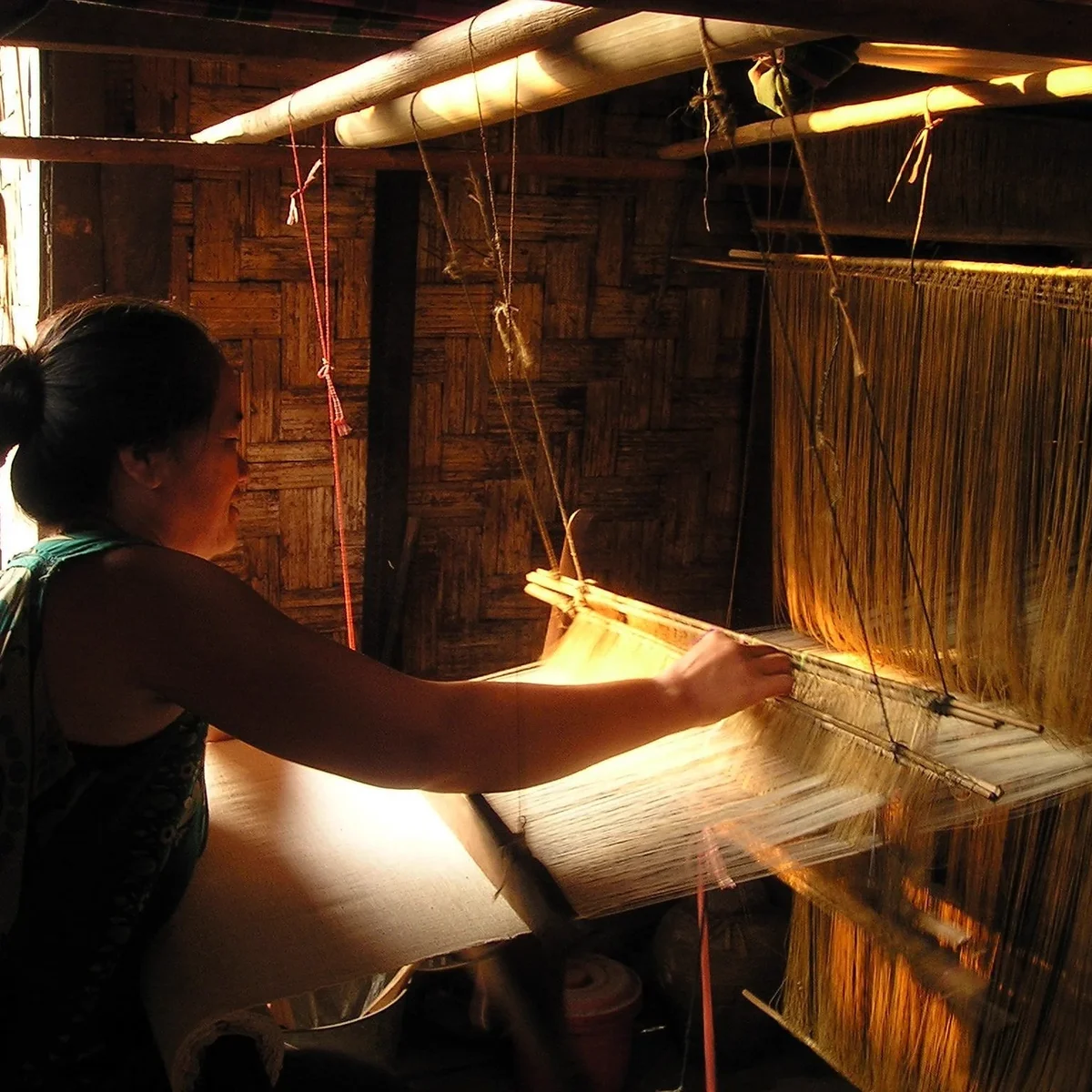
Silk Twill Weaving
Woven with a fine diagonal rib, silk twill gives a scarf its body, drape and subtle sheen — the standard set by the great silk houses.
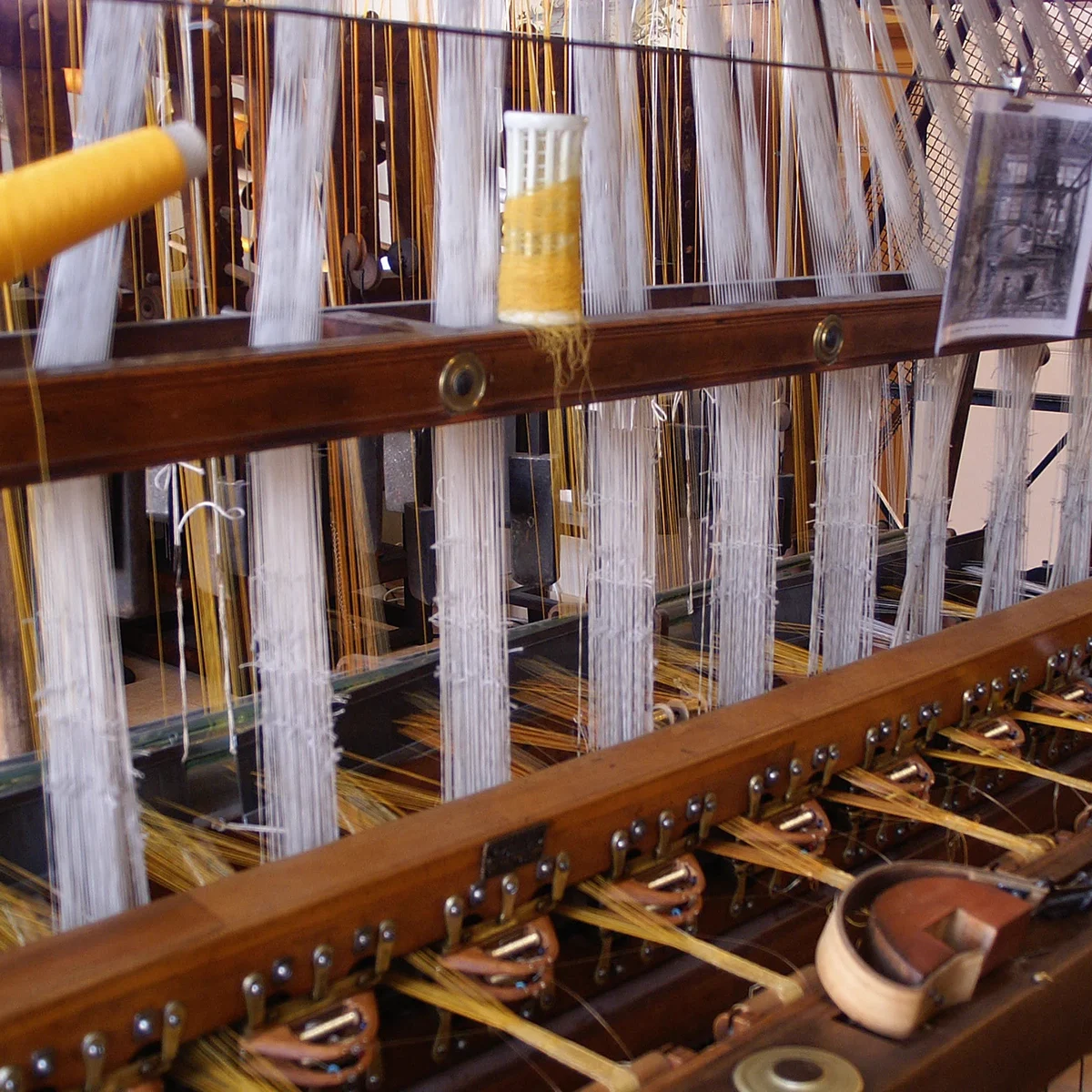
Digital Printing
High-definition digital printing reproduces millions of colours and fine detail, edge to edge, without the limits of screen printing.
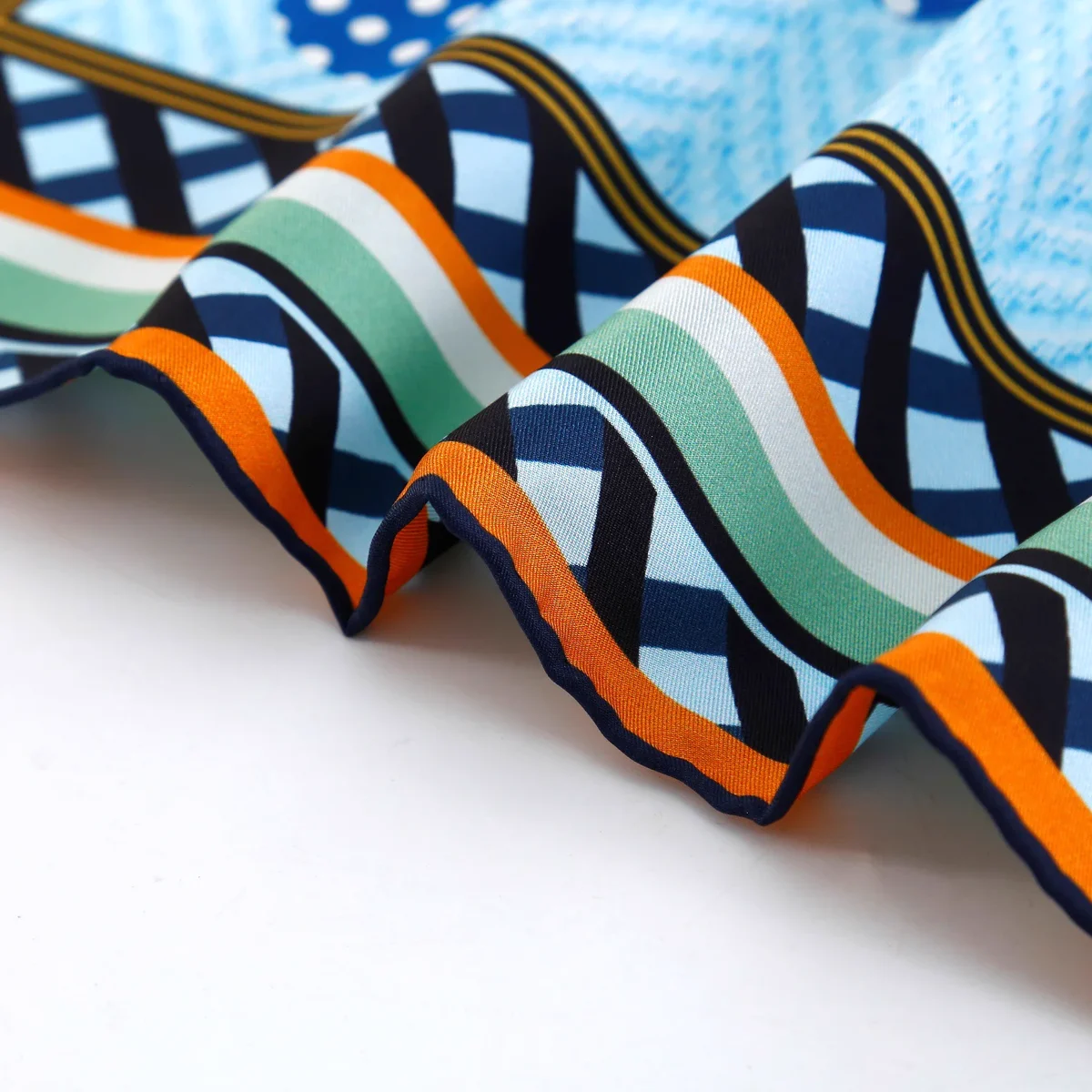
Hand Rolled Edges
Each scarf is finished with a hand-rolled, hand-stitched hem — a slow, skilled finish that is the signature of true silk craft.
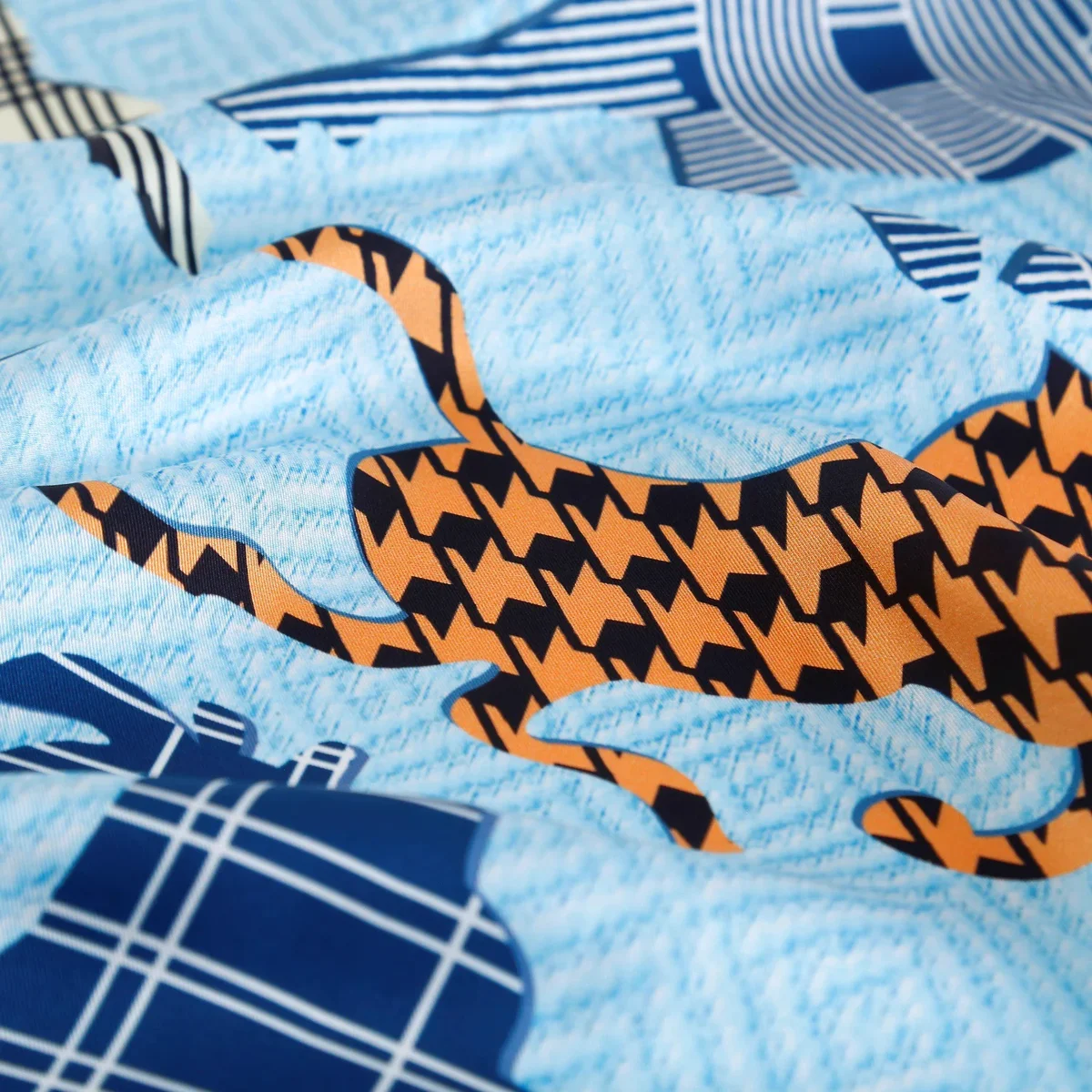
Mulberry Silk
The finest mulberry silk, weighed in momme. We select the right momme for structure, sheen and drape.
The Weave That Defines Luxury
Silk twill is a textile woven with a fine diagonal rib — the same weave chosen by the great silk houses for their signature scarves. The diagonal structure gives twill its distinctive qualities: a crisp body that holds a fold, a fluid drape that falls elegantly on the neck, and a subtle sheen that catches the light as it moves.
Unlike the flat surface of plain-weave silk, twill's diagonal grain gives the fabric depth. It prints colour with exceptional richness and saturation, because the twill structure reflects light across the whole surface — which is why the finest printed silk scarves in the world are, almost without exception, woven in twill.
Momme: The Measure of Silk
The weight of silk is measured in momme (mm). A higher momme means a denser, more structured silk; a lower momme means a lighter, more fluid one. We select the momme for each scarf according to its purpose — heavier twill for square scarves that hold their shape, lighter twill for neck scarves that fall softly.
It is worth saying plainly that momme measures weight and not quality. It says nothing about the grade of the raw filament, how evenly the silk was woven, or how the print was applied. A specification needs the number, but it needs the other lines too.
How a Custom Silk Scarf Is Made
Nine steps, in the order they actually happen. Everything from step three onward happens on cloth, not on screen — which is why a physical sample matters.
- 01
The artwork arrives
Send the design in whatever form you have it. We lay it out at the finished size with the repeat already positioned and the edges allowed for, and send the proof back before anything is printed. The proof costs nothing, and it is where a scaling or crop problem is cheapest to catch.
- 02
The cloth is fixed
Weave and momme are settled before printing, because the cloth decides how the print sits. The same file on silk twill and on habotai produces two visibly different scarves. This is the point at which the specification stops being a description and becomes a decision.
- 03
Colour separation
For screen printing, every colour in the artwork becomes its own screen, and the file is separated accordingly. For digital printing the file is prepared for the printer's colour profile instead. This step is where the number of colours in a design turns into a cost.
- 04
Sampling
A physical sample is produced on the actual cloth you have chosen — not a paper proof and not a stock scarf. A sample is the only place where a specification becomes real, and it is the last moment at which changing your mind is cheap.
- 05
Colour matching
If brand colour accuracy matters, the print is adjusted against your reference — usually a brand colour or a physical swatch. It happens during sampling. Once you approve a physical sample, later production is matched to that sample rather than to the original file.
- 06
Printing
Screen printing pushes ink through a mesh screen, one pass per colour, one screen per colour. Digital printing prints directly from the prepared file with no screen setup. Which one is right depends almost entirely on run length and how many colours the artwork carries.
- 07
Steaming and washing
Printed silk is steamed to fix the dye into the fibre, then washed to remove unfixed colour. The washing step is what brings the hand of the silk back — a freshly printed cloth does not yet feel like a finished scarf.
- 08
The edge
Each of the four sides is either rolled over and stitched by hand, or finished with a straight machine hem. This is the slowest step in the process and the most visible difference between a scarf finished as craft and one finished as a giveaway.
- 09
Pressing and packing
The finished scarf is pressed, folded and packed to your specification — plain polybag, or a branded box with a card, tissue and a care slip. Photographs of the finished order go out before it ships, so you can see what is in the cartons.
What You Can Specify, and What Each Choice Changes
Almost every question about a quotation comes back to these eight lines. Fix them and quotes from different suppliers become comparable.
| What you specify | Options | What it changes |
|---|---|---|
| Weave | Twill, charmeuse, crepe de chine, habotai, chiffon, georgette, organza, jacquard | How the cloth behaves in the hand and how the print reads. The single biggest decision. |
| Momme | 5 to 22, depending on the weave | The weight of the cloth. Decides whether the scarf holds a knot or floats. |
| Format | 90×90cm square, 53×53cm, 36×36cm, neck scarf, bandana, pocket square | How much cloth there is. Cost follows area, not the number of pieces. |
| Printing method | Digital, or screen | Digital carries no screen setup; screen printing adds a cost per colour and lowers the cost per piece at volume. |
| Number of colours | As many as the artwork carries | In screen printing, each colour is a screen and a pass. This is the line that moves most. |
| Edge finish | Hand-rolled and hand-stitched, or machine hem | Minutes of skilled hand work per scarf, on all four sides. |
| Labelling | Woven label, printed label, or none | Handled at packing. Worth settling early rather than at the end. |
| Packing | Polybag, or a box with card, tissue and a care slip | Whether the scarf can be handed over as it arrives. A retail decision, not a quality one. |
If you are choosing between the weaves, types of silk sets out all eight with the momme range each is normally woven at, and what your unit cost buys goes through where the cost actually sits.
Eight Silks, One Standard
Every scarf begins with the right silk. Here are the fabrics we weave, print and finish — with the detail on each on its own page.
Silk Twill
14–19mmA fine diagonal rib. Gives the cloth body, drape and a subtle sheen, and takes printed colour with depth — the standard weave for a printed scarf.
Silk Charmeuse
16–22mmA satin weave with a glossy face and a matte back. Softer and more fluid than twill, with more lustre.
Silk Crepe de Chine
12–16mmA lightweight plain weave made from alternately twisted yarns. The twist gives it a fine pebbled surface, and both faces look the same.
Silk Habotai
5–12mmLight, sheer and plain-woven — the most accessible of the silks. We usually weave it at around 8 momme for scarves and linings.
Silk Chiffon
5–8mmThe lightest and most translucent of the silks. Under magnification it resembles a fine net, which is where its airiness comes from.
Silk Georgette
8–12mmA sheer, dull-finished crepe. Springier and less lustrous than chiffon, with slightly more body.
Silk Organza
6–8mmA thin, sheer silk with a crisp, structured hand. Suits bridal, evening and packaging where a sculptural quality is wanted.
Silk Jacquard
14–19mmThe pattern is woven into the cloth on a jacquard loom rather than printed onto the surface, so it cannot wear off the face of the scarf.
Two Ways to Put a Design on Silk
Digital printing
The design is printed directly from a prepared file. There is no screen setup, so short runs and complex artwork are not penalised: photographic imagery, gradients and designs with a large number of colours all reproduce without the cost climbing with the palette. Digital printing reproduces colour very close to your artwork, but fabric is not paper — some colours fall outside what a printer can physically produce, and the closest achievable tone is printed instead.
Screen printing
Ink is pushed through a mesh screen, one screen and one pass per colour. It carries a setup cost per colour, and then prints cheaply per piece once the run is long enough to absorb that setup. It is the method for long runs with a limited number of flat colours.
The break-even between the two is not a fixed number — it depends on how many colours the artwork has. Ask for both quotes on your own design and the comparison will be on paper rather than in principle. If you want the detail on how a design reaches cloth, the printing page goes further.
The Edge Is Where You Can Feel the Difference
A scarf has four edges, and each one is roughly a metre long on a 90cm square. A hand-rolled edge is rolled over and stitched by hand along all four — a fine cord that runs the whole way round, with the stitching following the roll. A machine hem is a straight stitched line.
This is the slowest step in the process and the one most closely tied to what the scarf is for. A hand-finished edge is what makes a scarf read as craft, and it is a real cost. A machine hem is neat and durable, and for a promotional order, an event giveaway or a lining it is the correct answer — the hand work would never be seen.
There is a middle path worth knowing about: a scarf sold as a product but given away in volume does not need both. Specify the hand-rolled edge for the retail piece and a machine hem for the giveaway, on the same artwork — they are separate lines on the order.
Craft Questions Buyers Ask
What is the minimum order for a custom silk scarf?
A hundred pieces. A low minimum exists so that a design can be tested in the market, or a corporate or event order made viable, before committing to volume.
How long does a custom silk order take?
Around three weeks for production after sample approval. Sampling and colour matching come before that, so a project that needs a colour-matching step takes longer end to end than a reorder of an approved design. If your date is fixed, tell us the date at the start rather than the end.
Can I see a sample before committing to production?
Yes, and we would rather you did. A sample is produced on the actual weave and momme you have chosen, and if brand colour accuracy matters there is a colour-matching step during sampling. Once you approve a physical sample, later production is matched to it.
What printing methods do you use?
Digital printing and screen printing. Digital has no screen setup, so it suits short runs, photographic artwork, gradients and many-colour designs. Screen printing carries a setup cost per colour but prints cheaper per piece once the run is long enough to absorb it. Ask for both quotes on your own artwork.
What file should I send for the artwork?
Send whatever you have and we will tell you if it needs reworking. The useful things to include are the design at the highest resolution available, the finished size you want it printed at, and any brand colour reference. Everything else — repeat, bleed and placement — we will lay out and send back for you to check before printing.
Do you supply the silk and the finishing, or just the printing?
All of it. Weaving, printing, steaming and washing, and the edge finish all happen within our own production, which is why a specification can be adjusted mid-project without moving half-finished cloth between suppliers.
Where to Go Next
For the fibre itself, start with what silk is. For where it comes from, origins of silk. For the eight weaves compared side by side, types of silk. For the case for silk over a synthetic — including what silk does not do — read why silk. And to see the whole thing pulled together, the silk guide.
If you are ready to specify, the custom programme covers printing, logo scarves and private label, and MOQ and lead time sets out what a first run involves — 100 pieces minimum, around 3 weeks after sample approval.
Request a Sample
Feel the twill, see the print and judge the hand-rolled edge for yourself. We will send a sample before you commit to production.
Request a Sample