Silk Habotai
5–12mm momme
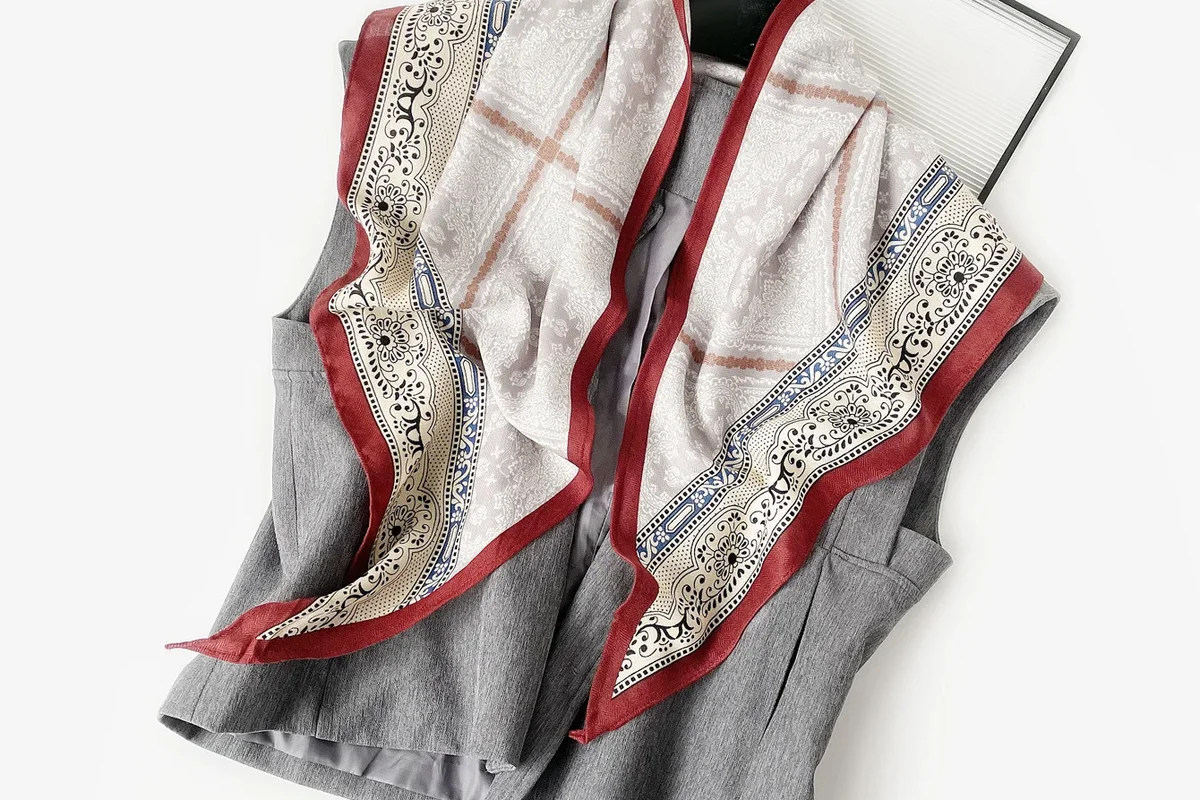
Habotai — also called habutai or pongee — is a lightweight, sheer, plain-weave silk and one of the most widely available silk fabrics. It ranges from as light as 5 momme to 12 momme, and our scarves are typically made in 8 momme habotai. It is an excellent, accessible choice for lightweight printed scarves and linings.
Habotai for Lightweight Printed Programs
Habotai is an accessible option for lightweight scarves, linings, promotional accessories and designs that need a soft, easy-to-wear hand. Its lower weight can help control material cost and shipping volume, but it also means that translucency and colour show-through should be considered in the artwork. Buyers should approve the actual momme, not only the fabric name, and check whether the print remains legible against skin or clothing. Sampling should include the selected hem finish, folded packaging and any woven label because lightweight fabric can respond differently to stitching and label weight.
Habotai on a printed scarf
Habotai — also called habutai or pongee — is a lightweight plain-weave silk, and one of the most widely produced silks in the world. It ranges from 5 to 12 momme, and the weight is the decision that matters most, because it changes the scarf more than the weave does.
At 8mm, habotai is light enough for a scarf to be worn indoors and packed flat without bulk, and it prints crisply. At the heavier end it has more body and hangs with less movement. Because the cloth is thin, some light passes through it, and that translucency interacts with the print: dense dark areas read solid, while fine light lines can pick up the colour of whatever is behind the scarf.
That is why habotai sampling should always include the print viewed against the colours it will be worn over, not only flat on a table. It is the one check that separates a habotai order that works from one that is approved on a proof and then disappoints.
Specification
The table below is what a quotation is built from. Fixing these lines before you compare supplier quotes is what makes two quotes comparable.
| Specification | This fabric | What it changes |
|---|---|---|
| Momme | 5–12mm (our scarves are typically 8mm) | Momme is weight. More weight means more raw silk in the same scarf, so it moves the unit cost more than any other single line. |
| Printing | Digital printing · screen printing | Habotai prints crisply at these weights. Because the cloth is translucent, check fine light-toned lines and small type against the colours the scarf will be worn over. |
| Edge finish | Hand rolled and hand stitched · machine hem | A hand-rolled edge adds a visible line of weight to a light cloth and helps the scarf hang. On the lightest weights, tell us at quotation stage if you want the hem kept narrow. |
| Format | 90×90cm · 53×53cm · 36×36cm · neck scarf · bandana · pocket square | Habotai suits the smaller formats well — 53×53cm, 36×36cm, bandana and pocket square. A 90×90cm square is possible but is very light in the hand. |
| Packing | Individual bag · branded box · carton mark | Packing is quoted as its own line so that it does not disappear inside the unit price. |
How habotai compares
| Weave | Momme | Weight in the hand | Choose it when |
|---|---|---|---|
| Habotai | 5–12 | Light, with some translucency | A light printed scarf at an accessible unit cost, or a lining. |
| Chiffon | 5–8 | The lightest and most sheer | Sheer, billowing styling is the point of the piece. |
| Crepe de chine | 12–16 | Noticeably more substantial | The scarf should feel matte and hold its shape at the neck. |
Buyer questions
Is habotai the same as habutai or pongee?
Yes — the three names describe the same lightweight plain-weave silk. Suppliers use them interchangeably, which is one reason it is worth agreeing the momme in writing rather than the name alone.
Which habotai weight should I choose for a scarf?
Our scarves are typically woven in 8mm. Above that the scarf gains body and hangs more heavily; below it the cloth becomes noticeably translucent. The right weight depends on whether the scarf is worn indoors or outdoors and how much show-through is acceptable in the artwork.
Is habotai see-through?
Some light passes through the cloth, so it is translucent rather than fully opaque. Dense dark print areas read solid; fine light lines can pick up the colour behind the scarf. Approving the print over the colours it will be worn with is the check that settles it.
Can habotai be used for a 90cm square?
It can, and the result is a very light square. If you want the 90cm format with more presence in the hand, crepe de chine or twill at a higher momme is the usual answer.
Minimum order, artwork and lead times
Minimum order is 100 pieces per design. A programme using several designs is quoted as several minimums, because each one is printed and finished separately.
You send whatever you have — artwork, a logo file, a reference, a brand guide, or an idea. We set the repeat, the layout and the hem allowance for your chosen format in habotai, and send a digital proof. Nothing is printed until you approve it. Artwork development is part of the project rather than a separate charge.
A physical sample is then printed and finished on the fabric you have chosen, and bulk production follows the approved sample. Bulk runs about 3 weeks after approval.
- What to send us: artwork or a logo file, the format, the quantity, and the fabric weight you want.
- What we send back: a digital proof, then a physical sample on your chosen fabric and edge finish.
- What we need before bulk: artwork approval, sample approval, and the packing method.
- What travels with the order: photographs of the finished scarves before they ship.